BLOGGER TEMPLATES AND TWITTER BACKGROUNDS »
Showing posts with label feminism. Show all posts

Wednesday, August 12, 2009

Damn straight, Hillary


Despite this completely appropriate response in which Hillary asserts her authority, and points out that she is an autonomous woman not reliant upon her ex-president husband, the Associated Press has published this gem: "US Official Struggles to Explain Clinton's Outburst."

Um...excuse me? How the fuck does her totally awesome response constitute an outburst? Anyway, I like how Melissa of Shakesville says it:

Nowhere in these reports will you read that Clinton's terse response was the appropriate diplomatic response to the question as posed to her.

The question, as asked, was a deeply misogynist one. It disrespected Clinton as the United States Secretary of State, and it disrespected her as a person, specifically because she's a woman. What does your husband think? You are merely the wife of an important man.
Of course, this may be an error in translation (at this point we're not sure if the translator goofed up, or the student asking the question did); nonetheless I don't think that Hillary Clinton's response was out of line or unwarranted.

What really bothers me is how this completely overshadows the purpose of Clinton's visit to the Congo in the first place, which was to raise awareness and seek to reduce the occurrence of rape against women. As Melissa states:

With that backdrop as a setting, Clinton's response to the question as asked was not only entirely appropriate, but excellent diplomacy on behalf on Congolese women.
Keep doin' what you're doin', Hillary--I adore you, and your unapologetic insistence at being treated like a human being.

-------------------------------------------------------------


I'd also like to include this video, via Shakesville (where the hell else?):


Of which, Melissa states:

Not only was Bush not described by the mainstream media after this incident as having "blown up" or "snapped"—his newest malapropism was, at worst, turned into a punchline, just another joke from a harmless clown (Oh, that kooky Bush! What a jokester!), but generally cited as more evidence of what a jus'-folks sorta brush-clearin' and straight-shootin' guy you'd like to have beer with. Just like all the rest of his bullying was by a fawning media.

Bush routinely affected an equivalently belligerent demeanor when questioned during press conferences. Never was he given the media treatment Clinton's received over the past few days. Not even close.

The double standard is gobsmacking, if totally unsurprising.

Tuesday, July 21, 2009

LOL you're a feminist!

A conversation with a male co-worker made me realize something: apparently me being open about my feminist inclinations is nothing more than ammunition for my co-workers, and even friends.

As a woman who frequently refers to her own feminist beliefs, I've encountered all kinds. Other feminists, and certainly womanists (especially since this term is not yet widely known, many people simply say this word doesn't exist, which is bullshit and shows that they know nothing about the nature of language) will know what I'm talking about. "Feminism" is a bad word. I've encountered men who are immediately turned off by that, writing me off as not worth the trouble--which is a good way to weed out men, as their reaction indicates to me that I'm saving myself a lot of frustration. I've also met my share of women who abhor not only the word "feminist" but the imagery it conjures up: the stereotypes of unshaven, unattractive women (I use these terms in the relative sense); the myth of angry bra-burners, cause some women to jerk away from this label, and even insult or ridicule the women that are open about their push for equality. I've encountered several that were afraid of being seen as a feminist, fearing it would deter dating prospects.

I've lost count of how many times I've had a woman laugh at me and say, "Oh, you're a feminist?"

So, I'm joking around with this co-worker, and he tells me and another male co-worker that he wants to quit his job and become a pimp, citing some made up income as reason enough to have "a couple of hoes." I laughed, and said, "Do you really want to have this conversation with a feminist?" To which he replied: "That's why I said it, because I know you're a feminist."

What's interesting to me about this exchange is actually a couple of things:

1). I am the only woman he said this "joke" to, specifically because I'm feminist, which made me realize that despite the numerous women I work with (I'd say that there's even a majority of women there) I'm the one he singled out with his obvious sexism and misogyny in the loving form of the "joke." I'm the lone woman muttering about women's rights.

2). This is another example of someone telling me something sexist and misogynist in the guise of a "joke," in a supposed illustration of their non-sexism. I could be wrong, but there are better ways to show someone you're not sexist. I know this co-worker was not being sincere, and he has indicated to me a number of times that he certainly respects women, and is not at all intimidated by successful women; so then, why make this joke?

3). My feminism is treated like an anomaly in which people prod at. It's almost like they expect me to be ashamed as they point it out and make jokes meant to incite that part of me. It's like they think it should be an insecurity that's fair game to all. I'm still trying to wrap my head around the compulsion some people have to knowingly say something offensive to purposely annoy someone. But then, I don't really understand this desire to be "edgy" either.

Apparently having the audacity to believe that women are not lesser than men warrants teasing. But then I'm feminist, and can't take a joke, right?

Sunday, May 31, 2009

Review: Pixar's Up

SPOILER ALERT

I saw Up yesterday, and, of course, loved it, as I knew I would. Everything about it--the fantastic premise of a man tying balloons to his house to travel to South America; the sense of adventure; the cute little chubby kid; the goofy dog who becomes pack-leader--EVERYTHING.

I felt the story of Carl, especially, was wonderfully portrayed. There are happy times with him and his wife Ellie, but there is the usual life's disappointments, such as having to put off a long-awaited trip to pay bills. And then there is the sad scene where they find out they're unable to have children. I was choking up when Carl bought the tickets to South America, but then Ellie dies before they can go on their trip. I found it quite touching that Carl was so devoted to her that he fulfills his promise no matter what. Carl's character is wonderfully portrayed, and we sympathize with him as he tries to maintain hold over his house and self--even as there is pressure to enter an old folks' home.

And then you have Russell, the adorable scout (I believe he's Asian--though thankfully not stereotypically Asian--yay!) who is driven to "assist" Carl to earn his final badge. He's also loving, determined to save Kevin, the bird, so she (yes, she) can get back to her babies (on a side note, I'm actually glad that when they realized that Kevin is in fact a "she" they didn't do that thing where they give her a feminine version of her name, or even change it to a "girl's" name). We also learn that Russell does not see his dad very often--getting the sense that he's one of those dad's that isn't very involved, and we see that Russell is dealing with his constant disappointment of his father, and missing even the simple things.

At the end of the movie, Carl and Russell both get what they've been missing in life, and they find it in each other.

Also, it was sweet when Carl realizes that Ellie's Adventure Book isn't blank in the section "Stuff I'm Going to Do," but is instead filled with pictures of her life with Carl.

I would like to point out that while I still love Pixar movies, I still wish we could have girls as main characters once in a while. I, as a girl, am able to relate to the males as they go on their adventures. I did not watch Finding Nemo or Up or Ratatouille in distraction because I was forced to relate to a male character, and so it is not a stretch of the mind AT ALL for boys and men to relate to girl characters. The story is not affected, but it at least gives us variety and equality in films, as well as illustrating that boys are not the only ones that can have adventures (that being said, I loved that Ellie was the more outspoken and adventurous person in Up; I only wish that she could have been there in more than just spirit, and while I don't think I would change anything in the movie, I would request that for future movies we don't use the death of the woman to uplift the male character (think of Up and Nemo).

While the scouts' ceremony is a touching scene that further illustrates the bond between Russell and Carl, I found it sort of odd that while Russell's mother is present, she was not standing up on stage with her son--she was in the audience. Just because all the kids are up there with dads is no reason to let your kid stand up there alone--he's not alone. Though I get that Russell has an absent father, they could have emphasized the relationship with the mother. Yeah, there's something missing, but he's not alone. I don't get along with my father and I don't talk to him much, but I wouldn't give up my relationship with my mother for anything.

Oh, and I have one more issue: all the dog characters that Muntz commanded were all male. They couldn't have made one female??? How hard would that have been? Just have a female voice for any one of the dogs--you don't even have to change the appearance of the dogs (since they're androgynous anyway).

I can't wait until this movie comes out on dvd. As with all other Pixar movies, I have to own it (well, except Cars, but I've got the others).

Tuesday, May 26, 2009

The elusive mythical creature: size 14 shorts

I had heard about how difficult it is for the average-sized lady to purchase clothing, but I hadn't experienced it firsthand until this last weekend. I haven't had to buy clothing in a while, and even when my dependable jeans suddenly rip, I convert them into a cute skirt, or I'll pick up something at Target or Wal-Mart. These places seem to understand those of us with a larger bottom. This understanding has not reached the higher end of the fashion spectrum, and certainly only exists in stores that specifically cater to those of us with some curves.

I was scouring my neighborhood mall last weekend (normally I avoid malls like the plague since I'm not a huge fan of people and children, but my fiance's family apparently loves malls, so there you have it). I had no intention of even looking at anything, since, as some of you already know, I'm broke and certainly can't justify spending $50 on a shirt I can make myself if I really felt like it, but my fiance's mother insisted, asking if there was anything I could use. I eventually picked out a few tank tops, and then was going to look for some shorts since I severely lack a summer wardrobe.

I quickly discovered that it is impossible to find shorts longer than crotch-length, and even more impossible to find anything above a size 10. I wear size 14; I'm not going to try to squeeze my ass into a size 10.

And then I just thought of how incredibly ridiculous it is that all these stores (and it's not just exclusive to my mall) don't carry clothing to accommodate the average-sized lady. Wouldn't they make more money if they carried items for the largest group of women customers? Average is average because more women fall into that group, yet these companies are willing to ignore them completely.

I will not starve myself so I can squeeze into their tiny shorts. There is enough shaming of women as it is without me feeling bad about myself because not one store carries shorts in my size. I was actually embarrassed trailing my fiance's mother in search of shorts that didn't exist. We must have gone into every store, and no luck in any of them. Who knew a pair of shorts for my ass would be mythical? Similarly, finding pants in my size is difficult.

I can easily find tops that fit properly, so why is it such an endeavor to find something to encase my butt? The clothing industry has apparently decided that the average woman is big fat fatty who doesn't deserve a fucking pair of designer jeans. They don't post an obvious "No fatasses" sign in their windows, but trust me, it's implicit in how they further your shame by pursuing a hunt for something they don't carry, or reducing you to asking for the size near the swarms of size 1's.

Perhaps one day the industry will realize that women come in all shapes and sizes and make clothing to reflect this reality. I have hips and curves. I am not pencil thin. I am average. I would like a pair of shorts that fits my body.

Tuesday, May 19, 2009

In my acceptance, I'm too sensitive; In other's hatred, they're standing up for what they believe in

This is something that's been bothering me for some time. I am sure my fellow womanists/feminists in the community will be able to relate; I have been told countless times that I am too sensitive, that I'm looking too much into something. This is the usual response I and others get when we call out racism, sexism, homophobia, and transphobia. As allies, we try to stand up and preach love and acceptance, human rights and equality for all, and instead of being praised for our bravery, our courage for speaking up against a person or group we challenge to think, we are accused of being weak and sensitive. Why does no one acknowledge how difficult and sometimes frightening it is to stand up to someone else, when sometimes that "someone else" is a member of our own family, or a beloved friend? Weakness would be not speaking up in the first place, not challenging the hateful beliefs of others that some people are worthy of privilege, and others are not.

And then you have someone like Carrie Prejean, whose beliefs have taught her that denying human rights to some people is okay. She is exulted for standing up for what she believes in (check out the comments), praised for her unwavering faith. Her faith and beliefs justify denying others human rights. While I myself am not religious, I come from a family that is--but my own mother knows enough that her faith is no excuse to hate others.

Standing by your beliefs is all well and good, but not when it legitimizes hatred. And also, if we're really going to praise people for standing up for what they believe in, then it should apply to me too, and others like me. I am not sensitive. I am not weak. Don't embrace someone else's hatred because she's adamant about a faith that excludes a large group of people and simultaneously charge me with "looking too much" into something. It's a blind sort of silencing dismissal, saying that what we believe and call out is unimportant. It's all bullshit.

Pixar's Inclusion of Women Characters: Thanks but no thanks

My previous Pixar post has gotten quite a bit of attention, and is even being linked to from other forums and sites. And, as should be expected, there's the token dude in there telling all the ladies they're "looking too much into it," stating that there are plenty of female characters in the movies. So I will now express my problems with this "defense." First, I will restate my previous and non-wavering point: Pixar films are male-centric even to the point where the directors and writers of said films are predominantly male; thus, it's ALL about the dudes.

Now, I will discuss the problems with female representation in the films (which may be a bit of a reiteration from my previous post, but bear with me).

Generally speaking, the women characters in Pixar films are mere tools of the men. Though women are, to some degree, involved, the focal points of the conflict and plot are always men. The men must do the journeying to some goal. If women are privileged with inclusion on said journey, they have the chore of nudging the man along. They are thus objects; they are tools the man gets to use to achieve his manliness.

Here's how I break it down:

  • Bo Peep (Toy Story): Does she even do anything other than serve as the sexual prize upon Woody's return?
  • Helen (The Incredibles): she's the homemaker. It is her job to raise her kids and her damn husband. While her husband is off trying to relive his glory days with his buddy, she's at home, having given up her superheroine-ness for family life (please note how much ass she previously kicked). She only reclaims the identity of Elastigirl when her husband goes AWOL and she's got to go get him back.
  • Violet (The Incredibles): She's the angsty teen (or preteen--not sure how old she is) and seems to be happy at the end because she's accepted her superheroine identity. And how does this serve her? She is suddenly able to get the attention of a boy she's had a crush on. Wonderful. A boy legitimizes her identity (aren't we sick of this cliche yet?).
  • Boo (Monsters, Inc.): she's an adorable infant who is the center of the conflict in the story. She doesn't really count as a female character because she can barely speak. She's just the wandering cute thing. Though the story is based on her being in the monster-world, she's just a baby barely interacting with it.
  • Celia (Monster, Inc.): she's the love-interest of one of the male characters. The only thing she really does is cause a distraction--oh you badass!
  • Dory (Finding Nemo): Like Boo, she doesn't really count. Her failing memory is a huge issue and she's pretty much there for comic relief (though I recognize it is because of her that Nemo is reunited with Marlin--though also recognize that shortly after they must rescue her--I mean, what a dumb bitch, getting caught in that net. Her capture legitimizes the relationship between father and son, and teaches the father a lesson on parenting).
  • Sally (Cars): she used to be a successful lawyer, but gave that up for the allure of the small-town. In her seduction of Lightning, she also makes him aware of the beauty of small-towns. Her goal to bring success to Radiator Springs is not as important as Lightning's journey and success. Great job, Sally.
  • Colette (Ratatouille): she's a tough woman, driven by her desire to succeed in a man's world. But then comes along the adorable goofball and her desire suddenly shifts from her own success to his. So she teaches him the shit and becomes his shadow.
  • Eve (Wall*E): she's a trigger-happy badass lady-robot--but her mission is clearly the secondary one. Though she's constantly saving Wall*E's ass, the viewer still understands that she's not the important one (uh, hello--whose name is the title??).
  • Princess Atta (A Bug's Life): her life is centered around her eventually becoming the Queen. She has authority over the colony, like her mother, but the story isn't about that. She's first seen as Flick's adversary, then his lover (the prize thing again). Her story is not the important one.
The commonality shared by all these lady-characters is that they do not really have goals or missions of their own, and if they do it's overshadowed by the goals of the men. Take Eve, for instance. Eve's mission, getting the plant to the captain, seems like it's more important than Wall*E's mission to get some hot hand-holding action; but we as viewers are still perched on the shoulders of the males (Wall*E's hand-holding trumps Eve's saving the human race--and don't even try telling me that Wall*E found the plant first--he doesn't know what it is; just that Eve is happy when he gives it to her; also recognize the link between the femininity of Eve and her directive to find plants--links femininity and nature). The story we are allowed to follow is that of the males.

Helen going off to fetch her husband; Dory struggling with her own elusive mind; Colette's aggressiveness in the kitchen*; these are all unimportant side quests. What really matters is what Marlin, Sully and Mike, Woody and Buzz, Lightning, Wall*E, Linguine and Remy, and Bob are all busy doing. Even the rats in Ratatouille are all male--the only lady rats we see are at the end listening to the story or admiring the muscles of the males (couldn't Remy have had a sister--and where's his mother? Those rats didn't birth themselves). All Remy's conflict is male-centered. Even his imagination conjures a man.

The point is the inclusion of a female character is not the same as actually making a strong female lead. Creating side characters that are quirky and ass-kicking women does nothing to assuage the fact that what Pixar thinks is important and relevant in stories encompasses the actions of men. Women are just tools along for the ride.

Up doesn't give me much hope either. Hell, even the damn dog is gendered male. It seems that Pixar has decided once and for all that women don't matter enough to even give them their usual side-character representations. Fuck.

Oh, and let me point out how cliche it is to treat strong female characters as exceptions to the rule. Strong women are not anomalies, and our stories are just as relevant as any man's.

-------------------------------------------------------
*Please note that the character of Colette isn't even all that fleshed out--we only see her in the kitchen--the one scene where she's not in the kitchen, she's contemplating the kitchen. We know nothing of her outside this setting.

Note: To all the menz who I'm sure are going to whine at me--go ahead. Argue with me. Your arguments are unfounded and blind.

Saturday, May 16, 2009

Salon's The virginity fetish

I'm all about sharing this week. So here's another article you should check out over at Salon called "The virginity fetish." The article explores Jessica Valenti's latest book called The Purity Myth: How America's Obsession with Virginity Is Hurting Young Women. "The virginity fetish" is an interview with the author about the book and she makes some very interesting points about how our culture views female sexuality as something both coveted and scorned.

You start the book by announcing that virginity … doesn't actually exist.

I did not know this [before I wrote the book]. I interviewed a woman named Hanne Blank, who wrote this great book called "Virgin: The Untouched History." She ran a Web site for teens about sex called Scarleteen, and the question she got most often from teenagers was, “I did such and such, am I still a virgin?” She was like, “You know, I don't know!” So, she went to the Harvard Medical School library to try to find a standard definition for virginity, and she couldn't find one. Apparently, there is no medical definition at all.

Virginity is completely culturally constructed, and obviously we each have our own individual understanding of what virginity is, but it's often a really limiting version of sexuality that doesn't include certain types of intimacy that are pretty important. Queer people are totally excluded -- if you're a lesbian with a number of partners, are you considered a slut? Probably not.

[...]

What do you think about the young woman who auctioned off her virginity?

I don't know why we're so surprised by it. This is going to sound terrible, but that's essentially the same thing the abstinence movement is saying: “Hold off until you can auction off your virginity to the person with the biggest ring.” It's really the same thing, only done in a more explicit and economically honest way.

I think it's really interesting whom we decide to call whores. [Natalie Dylan] is a whore because she's being really upfront and honest about it. But you would never think to call a woman who is getting married [for financial security] a whore.

[...]

How is it that a pop star like Britney Spears or Jessica Simpson can announce their virginity at the same time that they're successfully marketed as a sex symbol?

Because they're being exactly what pop culture wants them to be, which is the sexy virgin available for our consumption. We're able to watch them writhe around in music videos, but they're still good girls, so you can also prop them up as role models.

What was really interesting with Spears was that the media and public turned on her once she got pregnant, had a woman's body, became a little heavier, and could no longer be seen as this untouched virgin. People had to look at her as a full-grown woman and not a little girl. That's when they started to deride her and call her a whore, which goes to show that the women we fetishize most are not women but girls.

That's just part of it. It's a very insightful interview and I recommend that you read it in full. I'll probably end up buying her book at some point, but I'm a little poor right now, so I'll have to settle for interviews.

Friday, May 15, 2009

While I'm on my Wolverine kick

here are some feminist reviews of it. I was going to write one myself, but since it took me so long to see it everyone else beat me to it. That's all right though. They did an awesome job.

X-Men Origins: Wolverine — The Greatest Story Never Told? by K. Tempest Bradford.

X-Men Origins: Wolverine--Same Old Story by the angry black woman.

Basically these two discuss the issues with stories like these, which utilize female characters to serve and uplift the journey of the male ones; and of course when they're done, they're essentially disposable. They say it better though, so go check 'em out.

Monday, May 4, 2009

Call for suggestions for a feminist gal gettin' hitched

As some of you know, I got engaged to my lover of four+ years back in January. This last Saturday I attended my cousin's wedding, which was a lovely affair with all the glory of God and man and woman being made for one another...etc. While it was beautiful for them, I realized then that it wouldn't work for me or my fiance, since neither of us is religious.

I want my wedding to be special for the both of us, not just a celebration that I got me a man; but I don't want it to be a five-minute secular deal. I have agreed to let my mother do a reading from the Bible since I love and respect her and her religion as she loves and respects my decision not to have one, but I would like our officiant to share something meaningful with our friends and family sans God and Jesus.

If anyone has any suggestions for readings, I would love to hear them. I would like something androgynous since I don't wish to invoke the "standard" of heterosexual couple--none of this man and woman stuff; two people will work just fine. I also don't want one person being active, the other passive. At my cousin's wedding, a poem was read, the audience being the bride, who was told that her husband's hands will essentially serve her. While a romantic sentiment, it simply illustrated the ideas of wives being objects unto which husbands will execute actions. I want it to be about an equal relationship; not archetypes.

Anyway, I welcome all suggestions provided they meet the basic requirements. I suppose I could even write something myself (I've already made my wedding dress, so why not make more stuff?) but suggestions will get me thinking; and if there's already something out there I could borrow, then that's one less thing to worry about.

Have at it.

Friday, April 24, 2009

Obsessed: HOT INTERRACIAL CAT-FIGHT ACTION!


I have mixed feelings about this new movie. It's interesting that a white woman is cast as the seductive "other" woman, trying to break apart the happy marriage of a black couple. But then it also reinforces the "crazy bitch" thing, where some women are just "omg fucking crazy azz bitchez!" It also means that Beyonce's character must have a showdown with her opponent, since it's clear her husband won't. So now we have a sexy cat-fight! There you have it guys--psuedo-porn for the price of a movie ticket! Tell me it doesn't appeal to the male gaze: it is referred to as the "sexiest thriller yet."

For me, this only reaffirms that women are each other's enemies. You have to guard your man, or some other woman will come and sex him away from you. There's an interesting post on women bullying other women over at "Oh, You're a FEMINIST?!" Basically this movie is just another example of how women view other women as competition, and underscores the "necessity" to undermine other women in what appears as (and is) pettiness. This movie makes it extreme.

I don't know. I certainly don't see it as empowering. It's not any different than the hundreds of Lifetime movies with the same premise.

I dedicate my 50th post to Hillary Clinton

Mainly because she fucking rocks.


"Keeping women and men in ignorance and denied the access to services actually increases the rate of abortion." (Best quote ever).

We have found again and again that the best way to reduce teen pregnancy is a good education on safe sexual practices. The truth is teens are going to be engaging in sexual activities. Abstinence only education has failed failed failed. Yet millions of dollars fund this ignorant excuse for an "education." There is a great quote from Renee over at Womanist Musings that I think is highly appropriate:

I have said quite openly that when my child turns 12, I will buy his first box of condoms for him, with the understanding that I don’t want him participating in sex however; if he must act against my wishes I want him to be safe. I would much rather him have safe sex than to bury him at an early age because he has contracted HIV/AIDS. I love him enough to understand that my moral position on teenagers engaging in sex is not worth his life.
Everyone should have the right to an education that will prepare them for the responsibility of having sex, and teach them the risks and proper precautions associated with it. Keeping kids and teenagers in the dark about sex and how to protect themselves does more harm than anything. If we truly value the lives of others, and the well-being and reproductive health for women, then we will put millions of dollars into education and family planning. Abstinence-only education only reaffirms patriarchal control over women's bodies, and reinforces slut-shaming as a sort of fear tool to keep women's sexuality in check.

Monday, April 20, 2009

The Legacy of Poe: Return to the House of Usher

Note: As with all my literary analysis, there is a heavy SPOILER ALERT. While I do not give any explicit plot summaries, many of the things I discuss may reveal the plots, so if this happens to be a book sitting on your shelf you've been meaning to read, please read it first and come back. I'd hate to ruin it for you.

Return to the House of Usher
by Robert Poe was given to me by the professors of the English Department at my college, chosen by the professor which I was fortunate enough to do a one on one study of The Flowers of Evil. Fitting, since Baudelaire was a fan of Poe's, this new novel being a sort of sequel written by E. A.'s descendant. The events of the novel take place in little over a week, during a hurricane that, at first, is assumed to not come so far inland. The worsening weather provides a climactic backdrop for the story leading up to the second destruction of the famous house, now a Sanatorium founded by the new Roderick and Madeleine (who are twins).

This was a captivating novel, in that there was a drunk main character (and narrator), his best friend whose sanity slips because he is haunted by Edgar Allan Poe's story involving his ancestors, and both are involved in a sort of mystery involving a few awful secrets.

As usual, I interpreted this novel through my feminist lens.

Gender

I certainly hope it was intended that I hate the main character, though as many of you know intent does not always equal the result. As I have not met Mr. Robert Poe, nor have I read anything else by him (and I admit I don't even know if he has written anything else, though I could easily check), I do not assume that these ideas are indicative of him as a body existing outside the novel--as I safely assume the sexism of David Eddings based on the fact that I've read just about everything he's written, and the same sexist attitudes are present IN ALL OF THEM.

That being said, I hated the main character.

John Charles is a worthless drunk. He is a writer for the small newspaper in the fictional town of Crowley Creek. He has unresolved issues with his father--at some points he gets drunk and wallows in self-pity as he reflects on his poor relationship with his father, who is dead. He treats women poorly, and is guilty of the insulting objectification of them, and also of comparing cars to women.

With the three women characters provided,* we are presented with three versions of womanness.

Marilyn
In the first mention of Marilyn, we learn that she is "the town's sexiest woman" (31). She works as a hairstylist, and John Charles provides us with a colorful description of her:

Marilyn herself was a small, curvaceous blonde, whose ornate mop of curls would have made Dolly Parton stand up and take notice. I had always assumed her hair was a kind of professional advertisement. It had a sort of bedroom look that gave a man ideas (37).
Marilyn is presented as a woman whose main concern is her appearance, and she measures her looks off of other women. She's highly aware that she's beautiful, and finds that it is her duty to be as beautiful as she can so that men find her attractive:
Only one thing disappointed her: the hairstyles of the other women. "I don't know who they think they're kidding, John Charles," she told me as the waiter poured our wine, "but there's not a woman in the world who doesn't look better with big hair. Now look at the gal over there," she pointed to a plain-looking blonde in a black dress, dining with an older gentleman at a far table. "She's got a big rock on her wedding ring finger, so they can't be hurting for bucks, but she's done herself up dull as a dishwasher. With her money, she could have some decent highlights, get a little sex appeal, know what I mean? That guys she's with's been givin' me the eye for the last half hour. She's prob'ly boring him to death" (122).
Marilyn blames the man getting the "wandering eye" on the other woman's lack of superficial effort. Basically, if a woman isn't pretty enough, it's her fault her man fucks someone else.

But John Charles is one of those simple-minded menz:
She wore glittery blue stuff on her eyelids, which gave her brown eyes a sparkle, and a dark-red dress cut so low in front that I found it hard to concentrate on what she was saying whenever she leaned over to reach for the breadbasket. No question of my getting bored (123).
She probably wasn't saying anything important anyways.

Edith
We are introduced to Edith in the same scene we meet Marilyn. Her description sharply contrasts that of Marilyn, effectively creating two converse images of femininity:
An elegant-looking woman of an indeterminate age, her face seemed drawn and sad. She was looking into the mirror with an expression that seemed to suggest that whatever she saw there was not going to be sufficient to solve her current problems (37-8).
When John Charles speaks of Marilyn, age is never discussed--she's just attractive. With Edith, there's always a mention of her being older than he is. The word "elegant" also connotes a certain image associated with age, leading us to assume that Edith is not "young."

But Edith is not just some older woman that finds herself involved in a mystery surrounding the Usher place, aiding John Charles to figure out why Mayor Winsome, Mrs. Boynton, and Mr. Prynne are after the property. She's an intelligent woman, and also a motherly figure. Where Marilyn is single-minded and pretty, Edith is deep and nurturing. Her husband has just left her for his (supposedly younger and prettier) secretary (38), leaving her to care for their two teenage boys. Not only is this sudden situation difficult for her, but her ex has been telling the boys it's all her fault he's not around any more, turning them against her. She's constantly worrying about her children, since the man is known to have a temper (144-5, 232).

Mrs. Boynton
Completing the women and age spectrum, is the editor of the Crowley Sentinel. John Charles describes her as
a stout woman in her middle sixties, the epitome of a certain kind of Southern womanhood. Tough as nails, she ruled her domain with an iron hand and brooked no resistance from anyone. But underneath, she couldn't resist a little flattery and she had a vast and cynical understanding of human nature, which could always be appealed to in a pinch (61).
Boynton is also in on the deal to procure Usher's property, part of the bullying scheme to sell the land and house for less than it's worth. Basically, the impression we get of Boynton is that of a greedy old bitch. Which works, since this underscores the image of her being an old shrew.

John Charles
The entire novel is told from John Charles' point of view, and as such the women are filtered through his manly biases. His attitudes toward women are somewhat frustrating, when he tells the reader such things as "loud women's voices assailed my ears" (37) and "Sometime I'd like to be a fly on the wall when two women are talking. I've always wondered how they can go on for hours and hours and never once touch on anything important, like, say, cars, hunting or sports" (164); basically, typical manly things.

John Charles is particularly lovable when he helps his co-worker get his car out of the mud:
Back, sweet as a caress on a lady's soft skin, then put her in gear so gently and just slide her out of that sucking pothole[...]and she shot out like a greased pig. Damn, it felt good! (135-6).
Interesting how driving a car is synonymous with fucking a woman.

Chapter Seven is perhaps the best example of John Charles' despicability. He visits the town bar for (yet another) drink, and Marilyn joins him. How he treats her in this scene illustrates how he thinks of her as disposable:
I hadn't asked her to join me. I just wanted to get quietly drunk all by myself[...]
Marilyn looked at me. "I think maybe you should ease off a bit, John Charles. You have to drive home in the storm and I wouldn't want anything to happen to you."
It was none of her business[...]
I had forgotten she was there. I felt annoyed. Couldn't she see I was trying to concentrate. "I need to concentrate," I said to her.
"Well, thanks a lot!" she said.
I could see she was upset. One bad thing about women. They don't understand when a man needs to concentrate[...]
"Well, let me tell you one thing, Mr. Poe. I've had it up to here with hard-drinking men and I don't intend to have any more of 'em. You can't handle the whiskey, you can't handle me, you get my drift?"[...]
She got up and I watched her good-looking ass, in those tight jeans, sashay out of there. Quite a few other men watched it too. It's unfair, the way women do that. They always get the last word even when they don't say anything (184-7).
Revoltingly peppered throughout John Charles' sexism, is his insistence of his own Nice Guy-ness:
Why had she married him in the first place? I never get why smart, pretty women seem to go for the wild, irresponsible guys--the losers. The nicest guys I know seem to have no luck at all with women (144).
So nice of John Charles to pity Edith, while simultaneously engaging in victim-blaming.
He also admits:
It kind of makes my blood boil when a man takes off on a woman like that, after she's raised his kids and all. And it was not as if Edith Dunn had let herself go. For her age, she was a truly fine-looking woman (39).
Before he really gets to know her, he already has made assumptions about her regarding her roles as mother and wife--the first being that he assumes as a mother she is nurturing, and as a wife, she's a trophy (for her age).

As for John Charles and his being a man, there's an interesting scene in the novel that reeks of a masculinity struggle, between John Charles, and the New York mobster, Aldo Marco, who comes to Crowley Creek to get the Usher property. The hurricane reaches the town, and causes flood damage. As a result, a large crack appears from the foundation of the Usher house, splitting one wing of the house open. The two men exchange threats, John Charles telling Marco to back off and stop bullying the already unstable Roderick, and Marco hinting at causing harm to Edith if John Charles prevents Usher from selling the land (213-15).

So, to be clear, to John Charles, women are supposed to keep him interested, so they must be beautiful; they talk about nonsensical things; and even the "smartest" women are stupid because they fall for losers. Got it.

Oh, and he's also racist. The only black character in the entire novel doesn't even have a name (23). Here, a standard has been created in the novel, because the only time the race of a person is mentioned is with the black man, the "other." The rest of the characters have assumed whiteness.

Symbolism
Within the novel there is great use of metaphor and symbolism, which I'm sure was intended to echo the original story by Edgar Allan Poe. The storm itself is a symbol of destruction, its worsening effects foreshadowing the inevitable destruction of the House of Usher. Certainly it is not mere coincidence that the eye of the storm passes over the House of Usher when Edith and John Charles find Roderick after he'd been missing three days.

Similarly, the two peach trees mirror the illicit relationship between Roderick Usher and his twin sister, Madeleine, the "female" tree being the one that was ripped up in the storm, taking the entwined branches of the "male" tree with it (236), like Madeleine's threat to leave, and her death, did to Rod (258-59).

Conclusion

John Charles is an interesting character to read, since he's a self-centered sexist racist drunk. I think if I ever reread this novel I will take note of each time he drinks some whiskey--at least twice a chapter, I think. The final chapter is quite indicative about what really matters to John Charles in what he doesn't mention. For instance, what happened to Buzz, Aldo Marco's cousin who worked with John Charles at the Crowley Sentinel? After John Charles gets his car out of the mud, we don't see him again; we don't know if he survived the storm.

Similarly, we don't know what happened to the "ghosts," people supposed to be dead that Usher keeps locked in a room, hiding them from the state (and is thus the leverage that Marco uses to blackmail Usher into considering his property deal). But at the end, when John Charles is reflecting on everything that happened to Rod, Edith, the Mayor, Prynne, and Boynton, there is no mention of the old people--they're really alive, so where did they go? Who's caring for them now that they've been exposed to be alive? Clearly, these poor people are not worth an extra thought from John Charles. In the last chapter, he tells about the scars on his hands, mourns the loss of "the most beautiful trees," casualties of the storm (279), and even tells of how the tarn on the Usher property has polluted the land, condemning it. But nothing of the people that Rod Usher hid away and treated like prisoners.
------------------------------------------------------------------------------
*I chose not to include Madeleine in this analysis, since she's only alive for a few pages. She is certainly gendered. We first see her gathering daisies, and even her "ghost" carries a basket of dried daisies--certainly there is gendering involved when Roderick dresses up as her, haunting the grounds: everyone is fooled into thinking it's really Madeleine's ghost.


Works Cited
Poe, Robert. Return to the House of Usher. New York: Forge, 1996.

A great post on "sexting"

While doing my usual drink green-tea and catch up on blogs morning ritual, I came across a guest post over at Shakesville that I strongly recommend. It's about this new issue of teens "sexting," but the best part is it's written by a teenage feminist--the one perspective the media isn't considering. She also offers great insight in how we view sexuality. I recommend reading the whole post, but here's an excerpt which I found to be highly significant:

Young people are simultaneously not allowed to be sexual and pushed to conform to a hypersexualized, stereotypical idea of what it means to be desired. We're told that engaging in any sexual act sex is a dirty, dirrrty decision, despite the widely accepted fact that the vast majority of adults are doing it in some form or another. From there, we've got three basic paths to navigate—and I'll tell you right now that none of them end well:

a) If we don't have The Sex, we're prudes, geeks, goody-goodys. We're abnormal and utterly devoid of passion. We're the four-eyed nerd, not the bikini-sporting cheerleader. We're pathetic.

b) If we do but fail to use the right precautions—which is hardly surprising, given the ghastly prevalence of health curricula that 1) omit lessons on preventing pregnancy and STIs; 2) rely on blatantly sexist stereotypes and even flat-out lies about the purpose and efficacy of condoms and contraception; 3) fail to address the very real sexual health concerns of folks who are getting down with a partner of the same sex; and/or 4) skip right over the Sex chapter in the manual—we "should have known better."

c) If we do and use the right precautions WE GET SUSPENDED.

What the fuck?

Wednesday, April 8, 2009

"You'd entertain the universe..."

This is in honor of my man, Baudelaire. It's an early "Happy Birthday" to him, since it officially starts tomorrow, but my place of business doesn't care about poet's birthdays, so I'll celebrate tonight, and tomorrow night. So, to start, here's the poem from which I've taken my internet name. I think it's appropriate, since I identify as a feminist.

You'd entertain the universe in bed,
Foul woman; ennui makes you mean of soul.
To exercise your jaws at this strange sport
Each day you work a heart between your teeth.
Your eyes, illuminated like boutiques
Or blazing stanchions at a public fair,
Use haughtily a power not their own,
With no awareness of their beauty's law.

Blind, deaf machine, fertile in cruelties!
Valuable tool, that drinks to whole world's blood,
Why are you not ashamed, how have you not
In mirrors seen your many charms turn pale?
The magnitude of all your evil schemes,
Has this, then, never shrunk your heart with fear,
When Nature, mighty in her secret plans,
Makes use of you, o woman! queen of sins!
--Of you, vile beast--to mould a genius?

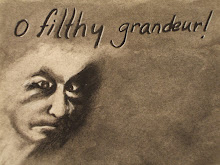
O filthy grandeur! o sublime disgrace!

Works Cited: Baudelaire, Charles. "You'd entertain the universe..." Charles Baudelaire The Flowers of Evil. Trans. James McGowen. Oxford: Oxford UP, 1993. 53-4.

Friday, February 20, 2009

Gendering sexless products

This is probably going to be the first of many posts about advertisements. I'm certainly not pointing out anything anyone else hasn't pointed out yet, but it's irritating and needs to be pointed out as many times as possible.

While watching t.v. at any given time, it is easy to see how products are given a gender based on who advertisers think will buy the product, and the result is this huge division between men and women (predominately white straight men and white straight women). Other groups don't seem to exist in commercials or ads.

One thing I learned is that beer is masculine, and is usually synonymous with watching sports (also masculine). Googling "beer ads" in an image search leads you to an array of print advertisements for beer, many of which portray airbrushed women (obviously for the straight male gaze). There's one that baffles me:
What we see here is a flat-chested woman exploiting the chest of the other woman. It isn't the large-chested woman shading her own beer, nor is it a man, which one would argue makes it not sexist. But this is still for a male gaze because it is invoking some perhaps not-so-subtle girl-on-girl action. Just look at how the woman is checking out the beer-shades.

Ad after ad shows hot women posing with beer to attract their male consumers. What this tells me is that beer isn't really for me. If I drink it, it's for the viewing of some man. Which sucks, because my beer-drinking is not supposed to be an exposition.

I also learned how for a woman, shampooing your hair is like some sort of sexual release. I can't think of any time where I shampooed my hair, and felt like this:
Energy drinks are male, and apparently will make something bigger?Chocolate is for women. Eat this and masturbate!
Except Twix, which supposedly allows men to be pigs, and still somehow get the lady:


Speaking of chocolate, here's a familiar Axe ad:

Since women find chocolate irresistible, you should smell like chocolate! Creepy and misleading? Of course it is! Check out any Axe commercial. It's all about getting teh ladiez. Therefore, if you're gay, Axe isn't for you. This whole getting "girl approved" shit alienates a whole demographic of men who are not into ladies...

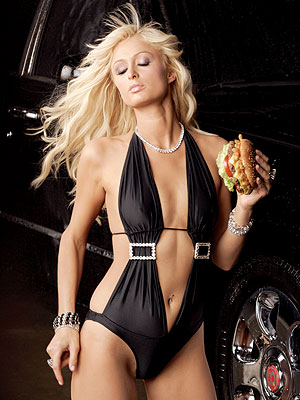
Burgers are for the male gaze, and sometimes invokes some pretty violent imagery:

Male:Racist:
So male they're actually testicles:I was also hoping to find video of the new Stacker 2 commercial, which heavily relies on the assumption that the dude is masturbating just before the hot woman enters his office, but I can't seem to find it anywhere just yet. I change the channel every time that commercial comes on.

What this all boils down to is that the ads that permeate our magazines and television is prevalently white and sexist. I didn't bother writing about the ads for children's toys, since that's a whole other argument. So I'll leave it up to Jared Logan: